Before you hire movers: 10 things to check
Before you hire movers for a move across state lines: check FMCSA registration, get a signed estimate based on a survey, pick your coverage and read every paper you sign.
Ready when: the company is registered with FMCSA, you hold a signed written estimate based on a survey of your things, you've chosen your liability coverage, and you know which papers you'll sign on moving day.
Hiring movers means handing almost everything you own to a company you met a few weeks ago, and often paying when it comes back. For a move across state lines, federal rules from the Federal Motor Carrier Safety Administration (FMCSA) decide what a mover must put in writing, how much it can demand at delivery and how claims work. This list follows those rules (49 CFR Part 375) and FMCSA's booklet Your Rights and Responsibilities When You Move, checked in November 2026. A move within one state falls under that state's rules, which vary a lot; your state attorney general or consumer protection office can tell you who licenses movers there. If you're renting at the other end, sort out the lease first with the checklist for signing a lease.
The Before List
- Check the company is registered with FMCSA. Look up its name and USDOT number at protectyourmove.gov before you book.
- Find out whether it's a mover or a broker. A broker arranges the move and hands your things to a separate moving company.
- Ask for a survey of your things. In your home or by video, so the price rests on what is actually going.
- Get a written estimate that you both sign. A price over the phone or in a text is not an estimate.
- Know which kind of estimate you have. A binding estimate fixes the price; a non-binding one can rise, with a cap at delivery.
- Choose your liability coverage on purpose. Full Value Protection is the default; the free option pays 60 cents a pound.
- List anything worth more than $100 a pound. Jewelry, silverware, china, furs, antiques and rugs need naming on the paperwork.
- Collect the papers the mover owes you. Two FMCSA booklets, its arbitration program, its tariff notice and its complaint process.
- Never sign a blank document. Only the actual weight and unforeseen charges may be left to fill in later.
- Read the delivery receipt before you sign it. Strike out any line that releases the mover from liability.
Why each one matters
Registration is the first filter. FMCSA's booklet says plainly to avoid brokers and movers that aren't registered with it, and to check at protectyourmove.gov. The name on your bill of lading has to be the name the company is registered under, with its physical address, so compare the two when the paperwork arrives.
Brokers are legal, but you should know when you're dealing with one. FMCSA defines a broker as a company that arranges your move with a registered moving company. A broker may only give you an estimate on a mover's behalf if it has a written agreement with that mover and uses the mover's published rates. Ask which company will carry your things, then look that one up too; the bill of lading lists the USDOT numbers of the carriers taking part.
The survey is what the estimate stands on. Federal rules require the mover to see your household goods, on site or virtually, before it estimates, unless you waive that in writing. The same booklet tells you to avoid movers that refuse to do one. A waiver means the price rests only on your own description of what you own, so think twice before signing it. Walk the surveyor through every room, the attic, the garage and the storage unit, and mention stairs, elevators and long walks to the truck, because the mover must work out charges for services like those before the bill of lading is written.
Only a written estimate counts. FMCSA's booklet says a verbal quote is not an official estimate. The real one is dated, signed by you and the mover, and covers transportation plus extra services. A mover can't charge you for a non-binding estimate, but it may charge for a binding one.
The type of estimate decides what you can be asked to pay at the door:
- Binding: you can't be required to pay more than the estimate at delivery, unless you add items or services. Changes have to be agreed before the truck is loaded.
- Non-binding: the final bill follows the actual weight and the mover's rates. At delivery, the mover must hand over your things once you pay 110% of the estimate, plus any services you asked for after the bill of lading was issued and certain charges for difficult access, capped at 15% of the rest. Anything above that is billed later.
With a non-binding estimate you also have the right to watch your shipment being weighed, and to ask for a free reweigh before it's unloaded. The final bill uses the reweigh, even if it comes out heavier.
Liability coverage is where people lose the most without noticing. Your estimate must show two options. Full Value Protection is the default and costs more: if something is lost or damaged, the mover repairs it, replaces it, or pays you for either. To get the cheaper option you have to waive it in writing, and then the mover owes no more than 60 cents per pound per article. FMCSA's own example: a 10-pound stereo component worth $1,000 would be worth no more than $6. Under Full Value Protection, the mover can also limit what it pays for any item worth more than $100 a pound unless you list it on the shipping documents. Ask the mover to explain that limit before you sign. If you buy separate insurance through a third party, disputes with that insurer fall outside FMCSA's rules.
The papers are your evidence later. When it gives you the estimate, the mover must also give you, or link you to, two FMCSA publications: Ready to Move? and Your Rights and Responsibilities When You Move. Before the bill of lading, it must also give you a notice that you can see its tariff, a summary of its arbitration program and a summary of how it handles complaints, with a phone number. FMCSA can't settle a dispute for you, so the arbitration program and the claims process are your route if something goes wrong. If a mover insists on cash, FMCSA's advice is to keep every receipt.
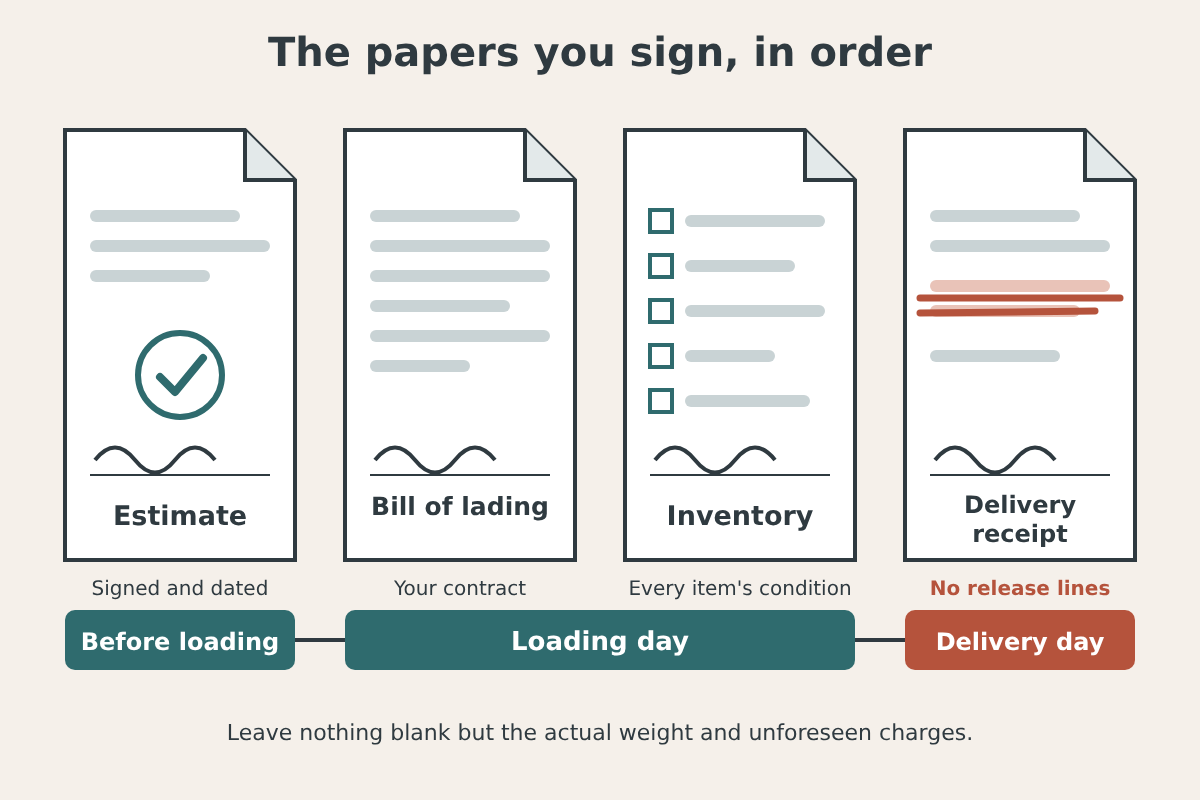
On moving day you'll sign two more things. The bill of lading is the contract for your move and the receipt for your shipment. The inventory, usually made at loading, lists each item with any damage or wear the mover sees. Read both before you sign, and add a note if you disagree with how an item is described. FMCSA says never to sign an entirely blank document. The only parts that may be left open are the actual weight on a non-binding estimate and charges that come up in transit or at destination.
The delivery receipt comes last. FMCSA's booklet says not to sign one that contains language releasing the mover or its agents from liability: strike that language out first, or refuse delivery if the mover won't give you a proper receipt. If something is lost or damaged, you have 9 months from delivery to file a written claim. The mover must acknowledge it within 30 days and pay, decline or make an offer within 120 days, telling you in writing why if it needs longer.
Countdown
6 weeks before
Make a list of what's going and what isn't. Look up three or four movers at protectyourmove.gov and ask each one whether it is a mover or a broker.
4 weeks before
Have each company survey your home, in person or by video. Compare written estimates, the type of each, and what Full Value Protection costs with each mover. Ask how they want to be paid at delivery.
The week before
Sign the estimate you chose and keep a copy with the two FMCSA booklets. Write down any item worth more than $100 a pound so it goes on the paperwork. Pack jewelry and important documents to carry yourself.
On the day
Walk through the inventory with the crew, read the bill of lading before you sign it, and ask where and when the truck will be weighed. Keep every page in one folder until the claim window closes. Once you're in, the new router checklist gets the internet working safely.
Mistakes people make
- Booking the cheapest phone quote without anyone seeing your things.
- Not realising the company you paid is a broker, and never checking the mover that shows up.
- Signing the Full Value Protection waiver without seeing that it means 60 cents a pound.
- Leaving a valuable item off the paperwork and finding out what that limits later.
- Signing a bill of lading with blank spaces because the crew is in a hurry.
- Signing a delivery receipt that releases the mover before checking for damage.
Ready check
- Have you looked up the company, and the actual mover if it's a broker, at protectyourmove.gov? If not, see items 1 and 2.
- Is your estimate written, signed and based on a survey of your things? If not, see items 3 and 4.
- Do you know whether it's binding, and what you'll pay at the door? If not, see item 5.
- Have you chosen your coverage and listed anything worth more than $100 a pound? If not, see items 6 and 7.
- Will you read every page before you sign on moving day? If not, see items 9 and 10.
Sources
- FMCSA: Your Rights and Responsibilities When You Move (49 CFR Part 375, Appendix A, as amended April 26, 2022)
- 49 CFR 375.401: Must I estimate charges?
- 49 CFR 375.407: Payment at delivery on non-binding estimates
- 49 CFR 375.213: Information a mover must give you
- 49 CFR 370.5 and 370.9: Acknowledging and settling claims
- FMCSA: Protect Your Move (registration lookup)
