Before you co-sign a loan: 10 things to check
Co-signing makes someone else's loan your debt. Check your budget, the Notice to Cosigner, the contract, release terms and your state's rules first.

Ready when: you could make every payment yourself, you've read the loan contract and the separate Notice to Cosigner, and you know how you'll hear about a missed payment.
Co-signing a loan means promising to repay someone else's debt if they don't. The lender treats it as your debt from the day you sign, and you get no share of whatever the loan buys. That can still be the right call for a child's first car or a family member rebuilding credit, but only if you could absorb the payments without hurting your own plans. This list uses US federal rules and guidance from the FTC and the CFPB, checked in November 2026. States add their own cosigner protections, so check yours, and talk to a consumer lawyer or a nonprofit credit counselor if the contract worries you.
The Before List
- Run the payments through your own budget. Assume you pay every month until the loan ends, plus late fees, and see whether that still works.
- Ask whether the borrower qualifies alone. Sometimes a smaller loan, a bigger down payment or a cheaper car gets them approved without you.
- Get the total you could owe in writing. Ask the lender for the full amount, including possible late fees and collection costs.
- Read the Notice to Cosigner. It's a separate page lenders covered by the FTC's rule give you before you're bound.
- Read the loan contract itself. The notice is not the contract; the contract has the rate, the term and what counts as default.
- Ask how you'll find out about late payments. Request monthly statements or online access to the account.
- Check whether the loan offers cosigner release. Read the exact conditions in the contract, and don't count on getting one.
- Talk through a plan with the borrower. Agree what happens if they lose their job or can't pay one month.
- Look up your state's cosigner rules. Some states require the lender to try the borrower first.
- Keep copies and check your credit reports. Keep the contract and notice, and pull your free reports regularly.
Why each one matters
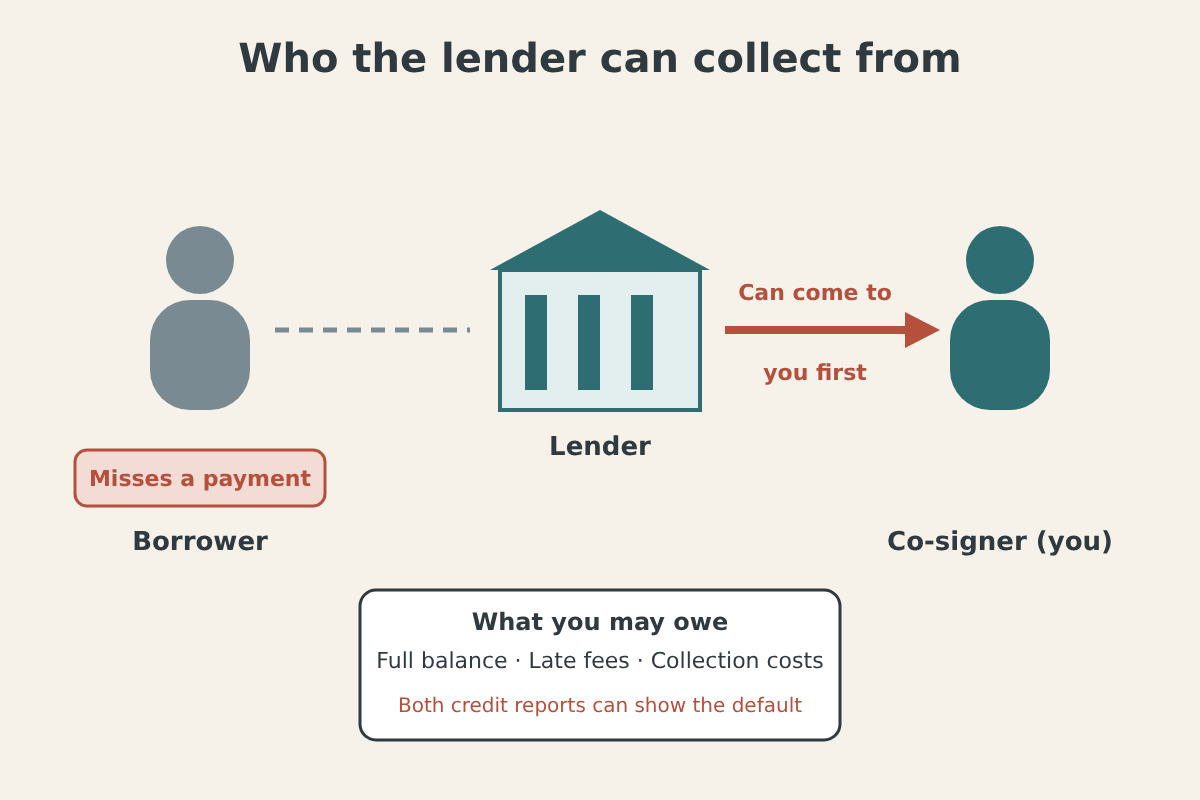
The budget test comes first because the promise is real. The CFPB says that if the main borrower doesn't make a monthly payment, you will be asked to make it. Missed payments can show up on your credit reports and lower your scores, which can make it harder for you to borrow later. On a car loan, default can lead to the lender repossessing and selling the vehicle, and depending on state law, the lender can sue both of you for what's left. The FTC adds that co-signing gives you no title or ownership of the car or anything else the loan pays for. Your only role is to repay.
Asking whether the borrower can qualify alone is a fair question, not an insult. The CFPB describes a co-signer as someone who adds their income and credit record to help the borrower qualify or get better terms. If a cheaper option gets them approved without you, everyone carries less risk. If the request is for a young adult's first credit card, what to check before a first credit card explains the under-21 rule and the habits that keep a card interest-free.
The Notice to Cosigner tells you the worst case in plain words. Under the FTC's Credit Practices Rule (16 CFR 444.3), lenders and retail installment sellers covered by the rule must tell you what you're liable for before you become obligated, and the rule's way to do that is this notice, given as a separate document. It says you may have to pay up to the full amount of the debt, plus late fees or collection costs. It says the creditor can collect from you without first trying to collect from the borrower, using the same methods it could use against them, such as suing you or garnishing your wages. And it says a default may become part of your credit record. The FTC notes that mortgage cosigners may not get this notice, so on a home loan, ask the lender to explain your liability in writing.
The contract matters as much as the notice, because the notice itself says it is not the contract that makes you liable. Read the interest rate, the number of payments and what counts as a default before you sign anything.
Hearing about a missed payment early is the cheapest protection you have. The CFPB suggests asking the lender for monthly statements or access to the online account, so you see a late payment before it turns into a default. The FTC also suggests keeping in touch with the borrower and keeping copies of the key loan documents.
Cosigner release is often promised and rarely granted. Some lenders advertise a way to take the co-signer off the loan later, usually after a run of on-time payments. In a 2015 review of private student lenders, the CFPB found that 90 percent of borrowers who applied for co-signer release were rejected, and that some company policies permanently disqualified borrowers who had accepted forbearance, a pause in payments. The FTC says a release may be possible if the loan agreement includes one and both the lender and the borrower agree, but lenders are unlikely to agree because it raises their risk. Plan as if you will be on the loan until the last payment.
State law can change the order of collection. The FTC notes that some states require the lender to try to collect from the borrower before coming to you. Your state attorney general's consumer protection office can tell you what applies where you live.
Your credit reports show what the lender is reporting. The three national credit bureaus, Equifax, Experian and TransUnion, let everyone check their reports for free once a week at AnnualCreditReport.com, the CFPB says. A co-signed loan should appear on yours, and so should any late payment. If you're also planning your own big step, such as signing a lease, the co-signed debt counts toward what you already owe.
Mistakes people make
- Treating it as a reference, not a debt. The lender can collect the full balance from you.
- Signing because it feels rude to say no. The CFPB says that if you feel uncomfortable or forced to sign, you should walk away.
- Assuming you'll be told about late payments. Set up statements or account access before the first payment is due.
- Counting on cosigner release to get out later. Many applications are turned down.
- Assuming you own part of what the loan buys. Co-signing gives you no title to the car or anything else.
- Pledging your own property as security without thinking it through. The FTC warns you could lose it.
Ready check
- Could you make every payment on this loan for its full term? If not, see item 1.
- Have you read both the Notice to Cosigner and the contract? If not, see items 4 and 5.
- Will you see a missed payment within a month? If not, see item 6.
- Do you know whether your state makes the lender try the borrower first? If not, see item 9.
Sources
- FTC: Cosigning a loan FAQs (updated April 2024)
- CFPB: Should I agree to co-sign someone else's car loan? (reviewed September 2023)
- eCFR: 16 CFR 444.3, Unfair or deceptive cosigner practices (FTC Credit Practices Rule)
- CFPB: CFPB finds 90 percent of private student loan borrowers who applied for co-signer release were rejected (June 2015, archived)
- CFPB: How do I get a free copy of my credit reports? (reviewed October 2026)
