Before you get your first credit card: 10 things to check
Pay in full, keep the grace period, read the agreement and know the under-21 rule: what to check before your first credit card.
Ready when: you can pay the full balance every month, you've read the card's agreement, and you know your statement date and due date.
A first credit card is a cheap way to build a credit history, as long as you pay the whole balance on time. Carry a balance and you pay interest at the card's APR, usually from the day of each new purchase. This list uses US federal rules and CFPB guidance checked in November 2026. Rates and fees differ from card to card, so the card's own agreement is the final word. No card is recommended here, and if you're already juggling debt, a nonprofit credit counselor is a better first stop than a new card.
The Before List
- Decide what the card is for. A few regular purchases you'd make anyway, paid off each month, is the simplest plan.
- Check your credit reports first. They're free every week at AnnualCreditReport.com.
- Know the under-21 rule. Under 21, you need your own income to make the payments or a co-signer who is at least 21.
- Read the cardholder agreement before you apply. Fees, the APR, and your liability for unauthorized charges are all in it.
- Find the APR for purchases and for cash advances. They are often different, and both should be disclosed before you agree.
- Confirm the card has a grace period. Most cards do on purchases, but they don't have to.
- Set up autopay for at least the minimum. Then pay the full statement balance by hand, or set autopay to the full balance.
- Learn your statement date and due date. The bill must be mailed or delivered at least 21 days before the payment is due.
- Skip cash advances. Interest usually starts the day you take one.
- Keep the limit small at first. A low limit makes the balance easier to pay in full.
Why each one matters
Paying in full is what makes a card free to use. The CFPB says that on most cards you can avoid paying interest on purchases if you pay your balance in full each month by the due date. The time between the end of a billing cycle and the due date is the grace period, and it only protects you while you keep paying in full.
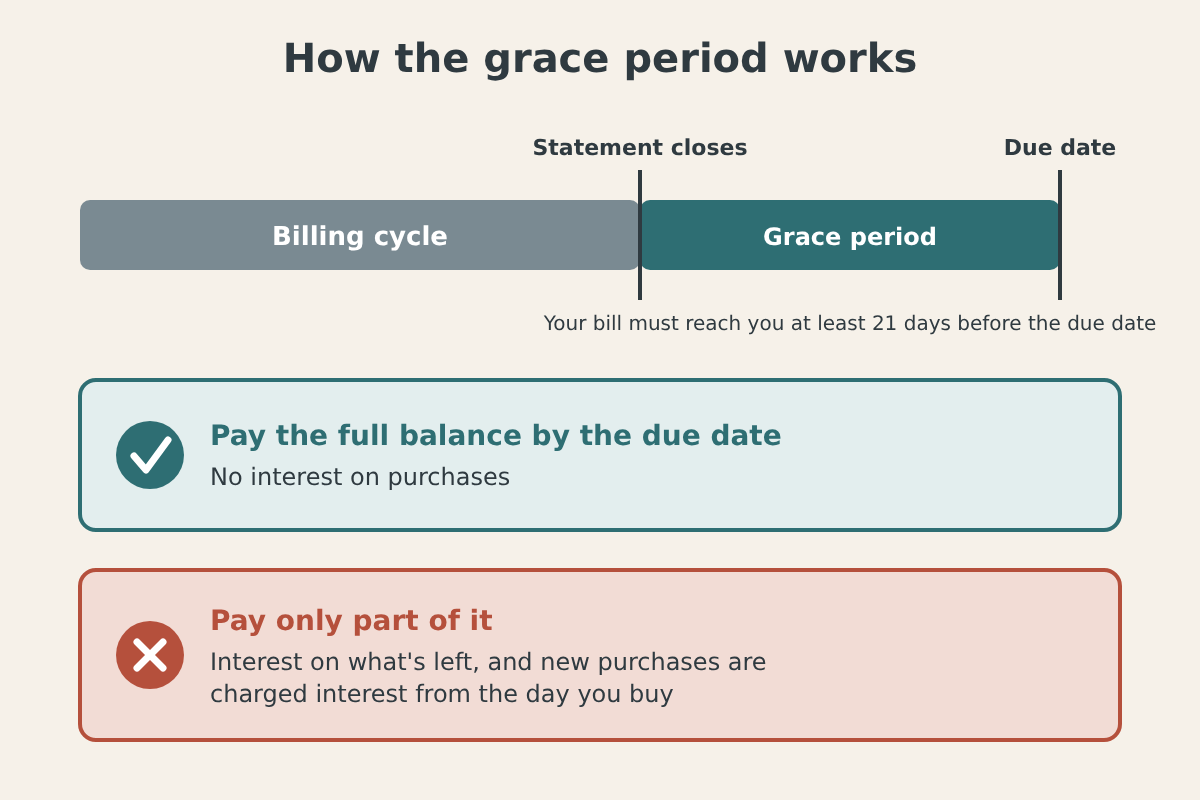
Losing the grace period costs more than people expect. If you don't pay the balance in full, the CFPB says, you're charged interest on the unpaid part, and on new purchases in the next billing cycle from the date each one is made. Pay in full some months and not others, and you can lose the grace period for the month you don't pay in full and the month after. Card companies aren't required to offer a grace period at all, which is why item 6 is worth checking. And grace periods usually cover purchases only: with a cash advance or a check from your card issuer, interest generally starts on the day of the transaction.
Your credit reports are where the card's history will show up, so start by seeing what's already there. The three national credit bureaus, Equifax, Experian and TransUnion, let you check your reports for free once a week at AnnualCreditReport.com, the CFPB says. Look for accounts you don't recognize before you apply.
The under-21 rule surprises many students. According to the CFPB, the Truth in Lending Act generally bars card companies from issuing a card to anyone under 21 unless they can show an independent ability to make the payments, or someone over 21 co-signs and agrees to be responsible if they can't. A parent who co-signs takes on the full risk; what to check before you co-sign a loan covers what that means. The CFPB adds that lenders otherwise can't use age to discriminate against you.
The agreement tells you what the ad doesn't. The CFPB describes the cardholder agreement as the document that sets out the card's fees, its APR and your liability for unauthorized transactions, and says your card company must disclose the APR before you agree to use the card. Issuers are generally required to post the agreements they offer on their websites, and the CFPB keeps a searchable database of agreements from hundreds of issuers, so you can read one before you apply.
Paying on time also protects your rate. The CFPB notes that if you're more than 60 days late on a payment, the card company can raise the interest rate on all your balances. Autopay for at least the minimum stops a busy month from turning into a late payment, and the CFPB says the bill must be mailed or delivered at least 21 days before it's due, so you have time to pay the rest. If you're heading off on a trip with a new card, the holiday travel checklist covers what to sort out before you fly.
Mistakes people make
- Paying only the minimum. Interest builds on what's left, and new purchases start costing interest too.
- Taking a cash advance in a pinch. Interest usually starts the same day.
- Applying without reading the agreement. Fees and rates are in it, not in the ad.
- Missing a payment by two months. A rate increase on every balance can follow.
- Assuming every card has a grace period. Check before you apply.
Ready check
- Can you pay the full balance every month? If not, see items 1 and 10.
- Have you read the agreement and found the purchase and cash advance APRs? If not, see items 4 and 5.
- Is autopay set up for at least the minimum? If not, see item 7.
- Do you know your statement date and due date? If not, see item 8.
Sources
- CFPB: What is a grace period for a credit card? (reviewed September 2024)
- CFPB: What is a credit card interest rate? What does APR mean? (reviewed August 2023)
- CFPB: Can a credit card company consider my age when deciding to lend me a card? (reviewed June 2023)
- CFPB: Credit cards key terms
- CFPB: Credit card agreement database
- CFPB: How do I get a free copy of my credit reports? (reviewed October 2026)
