Before you quit your job: 10 things to check
Health coverage, your final paycheck, vacation payout and your 401(k): what to check before you hand in notice, with a countdown to your last day.

Ready when: you know when your health coverage ends, what your last paycheck will include, and where your 401(k) money will go.
Quitting is mostly paperwork you can do before you hand in notice, while you still have access to HR and your benefits portal. The money questions are the ones that bite: health coverage, the final paycheck, unused vacation and retirement savings. This list uses US federal rules and guidance from the Department of Labor, the IRS and HealthCare.gov, checked in November 2026. Final pay, vacation payout and unemployment rules are set by each state, so confirm them with your state labor department. If you're leaving over a dispute, or you've been offered a severance agreement, have an employment lawyer read it before you sign anything.
The Before List
- Find out the day your health coverage ends. Ask HR whether it stops on your last day or at the end of the month.
- Pick your next health coverage. A new employer's plan, COBRA, or a Marketplace plan through a Special Enrollment Period.
- Ask what your final paycheck will include and when it arrives. Get the date and the items in writing.
- Check your vacation payout policy. The handbook and your state's law decide whether unused days are paid.
- Look up your 401(k) vesting. Your own contributions are yours; employer matches may not be yet.
- Choose where your 401(k) goes. Leave it, move it to a new plan or roll it into an IRA, and ask for a direct rollover.
- Read your contract and handbook for notice rules. Notice periods, non-competes and what happens to bonuses.
- Save your own records. Pay stubs, your last W-2, benefits statements and contact details you'll want later.
- Know where you stand on unemployment. Benefits are generally for people out of work through no fault of their own.
- Run your budget without the paycheck. Count the gap until the next one, plus higher health costs.
Why each one matters
Health coverage is the most expensive thing to get wrong. If your employer had 20 or more employees in the prior year, the Department of Labor says COBRA generally lets you keep the group health plan for a limited time after you leave, but you may have to pay the entire premium, up to 102% of the plan's cost. Compare that with the premium that comes out of your paycheck now. HealthCare.gov offers another route: losing job-based coverage qualifies you for a Special Enrollment Period if the loss was in the past 60 days or is expected in the next 60 days, so you can line up a Marketplace plan before your last day. Its savings depend on your expected income for the year, which may be lower than it was. If you take COBRA and it later runs out, you get another 60 days to enroll in a Marketplace plan.
Your last paycheck can arrive later than you expect. The Department of Labor says federal law does not require employers to give former employees their final paycheck right away, though some states require immediate payment. If the regular payday for your last pay period passes without payment, the Department suggests contacting its Wage and Hour Division or your state labor department.
Vacation payout is not guaranteed by federal law. The Fair Labor Standards Act does not require payment for time not worked, such as vacations; the Department of Labor calls vacation benefits a matter of agreement between employer and employee. Your handbook and your state's rules decide whether unused days are paid out, so check both before you plan around that money.
Vesting decides how much of the 401(k) is yours to take. The IRS says your own elective deferrals are always 100% vested. Employer matching contributions can follow a schedule: either fully vested after 3 years of service, or vesting gradually and fully vested after 6. In the IRS's own example, someone who leaves after 2 years in a plan with 3-year cliff vesting keeps none of the match. If you're close to a vesting date, it may be worth knowing before you set your last day.
How you move the money matters as much as where it goes. Ask for a direct rollover, where the plan pays the new plan or IRA itself.
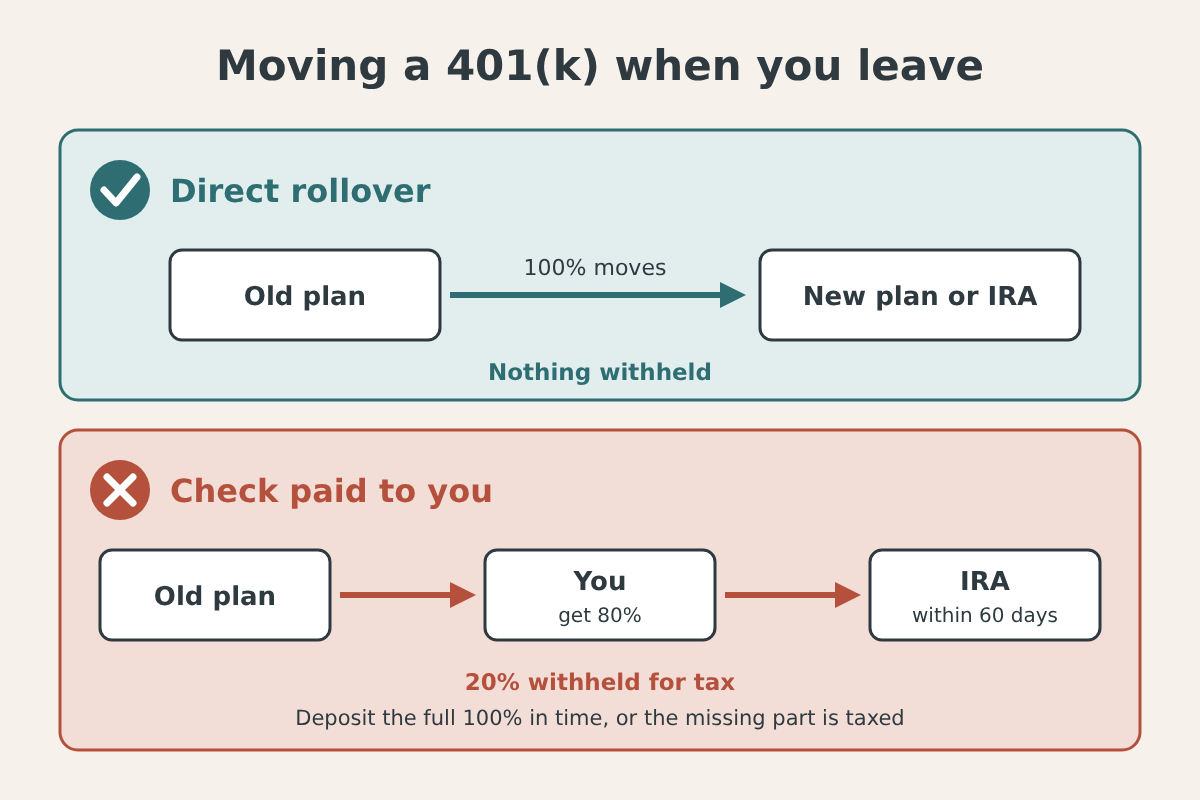
The IRS says a retirement plan distribution paid to you is subject to mandatory 20% withholding, even if you plan to roll it over. You then have 60 days to deposit it in an IRA or another plan, and to keep the whole amount tax-free you have to make up the withheld 20% from other money. Anything you don't roll over is taxable and may face the 10% additional tax on early distributions. A direct rollover avoids all of that.
Unemployment is run by each state. The Department of Labor says each state administers its own program, and eligibility generally requires being unemployed through no fault of your own and meeting the state's work and wage requirements. Quitting usually makes that harder, but states decide, so check your state's rules before you count on benefits.
If you're leaving to work for yourself, what to check before you go freelance covers quarterly taxes, records and health insurance. And if the new job means a move, the lease checklist is the next step.
Countdown
4 weeks before
Ask HR when coverage ends, what the final paycheck includes and what your vesting looks like. Compare COBRA's cost with a Marketplace quote.
The week before
Request the direct rollover paperwork or decide to leave the 401(k) where it is for now. Download pay stubs and benefits statements while you still have access.
On your last day
Confirm your final pay date and forwarding address for your W-2, and return company equipment.
The 60 days after
Start new coverage inside the Special Enrollment window or elect COBRA, and check that the rollover arrived in full.
Mistakes people make
- Assuming health insurance lasts to the end of the month. Ask for the date.
- Cashing out the 401(k) by accident. A check made out to you comes with 20% withheld and a 60-day clock.
- Counting on a vacation payout that the policy or state law doesn't require.
- Leaving a few months before employer contributions vest without knowing it.
- Losing access to pay stubs and benefits records along with the work login.
Ready check
- Do you know the exact day your health coverage ends and what replaces it? If not, see items 1 and 2.
- Do you know when your final paycheck arrives and whether vacation is paid out? If not, see items 3 and 4.
- Have you asked for a direct rollover or decided to leave the 401(k) in place? If not, see items 5 and 6.
- Could you cover your bills until the next paycheck? If not, see item 10.
Sources
- Department of Labor: Continuation of health coverage (COBRA)
- HealthCare.gov: Special Enrollment Period
- Department of Labor: Last paycheck
- Department of Labor: Vacation leave
- IRS: Issue snapshot, vesting schedules for matching contributions
- IRS: Rollovers of retirement plan and IRA distributions
- Department of Labor: Unemployment insurance
