Before you go freelance: 10 things to check
Self-employment tax, the four estimated tax dates, records, health insurance and a retirement plan: what to set up before you go freelance.

Ready when: you've set money aside for taxes, you know the four estimated tax dates, you have health coverage lined up and a way to track income and expenses.
Going freelance means doing the jobs a payroll department used to do for you: setting aside tax, paying it four times a year, keeping records and finding your own health insurance and retirement plan. None of it is hard once it's set up, and all of it is easier to set up before the first invoice than after. This list uses IRS, HealthCare.gov and SBA guidance checked in November 2026, with 2026 figures where they apply. State and local taxes and licenses vary, so confirm with your state's revenue department and your city or county. A tax professional is worth paying for the first year if your income is uneven or you're unsure what you can deduct.
The Before List
- Set aside money for self-employment tax. It's 15.3% for Social Security and Medicare, on top of income tax, with no employer to split it.
- Put the four estimated tax dates in your calendar. April 15, June 15, Sept. 15 and Jan. 15.
- Open a separate account for business money. One place for client payments and business costs makes records and taxes simpler.
- Pick a way to keep records from day one. Any system works if it clearly shows income and expenses.
- Decide whether you need an EIN. It's free from the IRS and lets you open a business bank account.
- Check state and local licenses and zoning. Rules depend on your work and where you live, even for a business at home.
- Line up health coverage. The Marketplace is open to freelancers, and leaving job-based coverage opens a Special Enrollment Period.
- Choose a retirement plan. A SEP-IRA, a one-person 401(k) or a SIMPLE IRA replaces the workplace plan.
- Set up a work-only space if you'll claim a home office. The deduction needs regular and exclusive business use.
- Build a cushion for slow months. Client payments come late and unevenly, and the tax bill still comes on time.
Why each one matters
Self-employment tax is the surprise most new freelancers meet first. The IRS sets the rate at 15.3%: 12.4% for Social Security and 2.9% for Medicare. An employer would normally pay half; now you pay both. For 2026, the Social Security part applies to the first $184,500 of combined wages, tips and net earnings, and the Medicare part applies to all of it. You owe self-employment tax and file Schedule SE once your net earnings from self-employment reach $400 or more. You can deduct the employer-equivalent half when you work out your adjusted gross income, which lowers income tax but not the self-employment tax itself.
Estimated tax replaces the withholding on a paycheck. The IRS says people in business for themselves generally have to make estimated tax payments if they expect to owe $1,000 or more when they file, and those payments cover income tax and self-employment tax together. Pay too little, or pay late, and you may owe a penalty even if you end up due a refund. Most people avoid that penalty if they owe less than $1,000 after withholding and credits, or if they paid at least 90% of this year's tax or 100% of last year's, whichever is smaller (higher earners have a different rule).
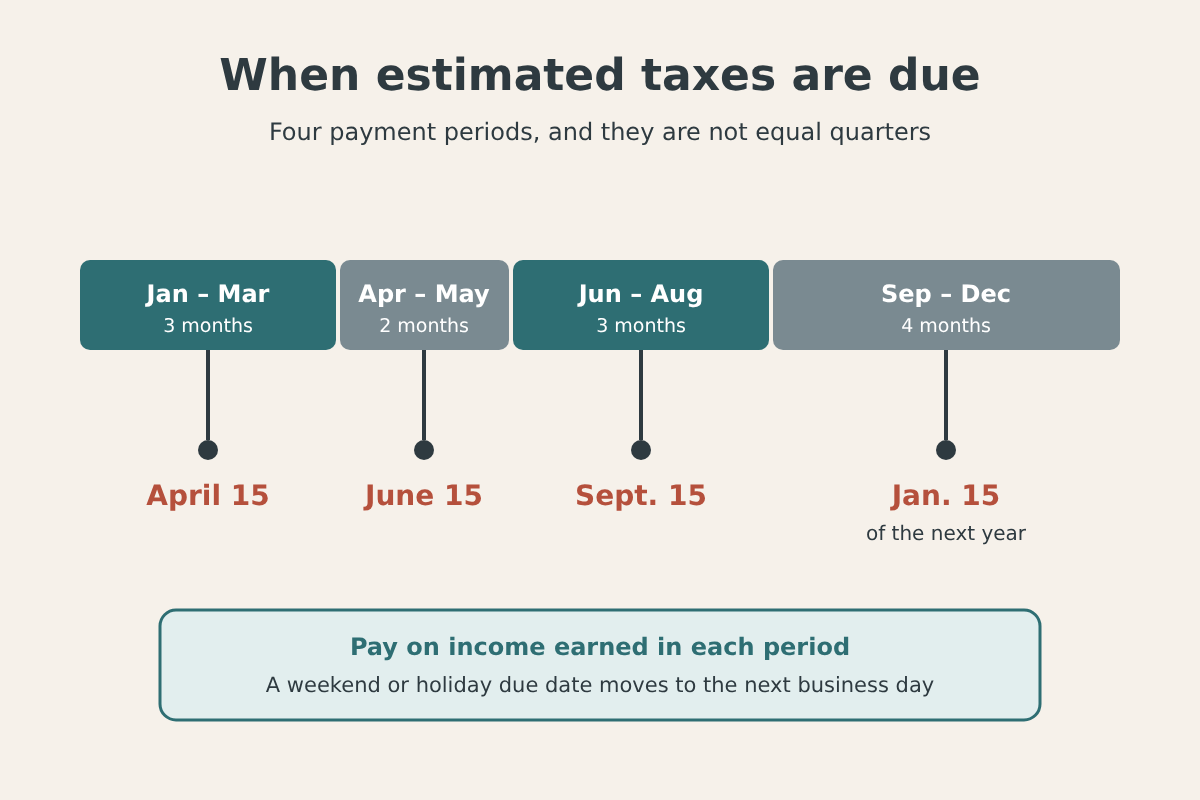
The year is split into four payment periods, and they aren't even: January to March is due April 15, April and May are due June 15, June to August is due Sept. 15, and September to December is due Jan. 15 of the next year. A due date on a weekend or holiday moves to the next business day. You can pay online, by phone, through the IRS app or by mail with Form 1040-ES, and you can pay more often than quarterly as long as enough is in by each date. In your first year, Form 1040-ES has a worksheet for estimating income you haven't earned yet; if you guess wrong, refigure it for the next period.
Records are what let you prove your deductions. The IRS says you can use any recordkeeping system suited to your business as long as it clearly shows income and expenses, and that you must keep records as long as needed to prove the income or deductions on a return. The burden of proof is yours. If you'll put business costs on a credit card, paying the full balance each month keeps them interest-free; what to check before a first credit card explains how the grace period works.
An EIN is free and quick. The IRS issues one online at no cost, and the SBA notes that an EIN lets you open a business bank account.
Licenses and zoning are local. The SBA says your location determines the taxes, zoning laws and regulations a business is subject to, and that zoning ordinances can still apply to home-based businesses. The SBA suggests checking with your city planning department about zoning, and your state and city decide which licenses your work needs.
Health insurance needs a plan before your job-based coverage ends. HealthCare.gov says freelancers, consultants and independent contractors without employees can buy coverage through the individual Marketplace, and losing job-based coverage for any reason qualifies you for a Special Enrollment Period. Savings are based on your estimated net income for the coverage year, so estimate that income carefully and update it if it changes. If you're still in your job, what to check before you quit covers COBRA, the final paycheck and moving your 401(k).
Retirement saving doesn't stop with the employer plan. The IRS lists a SEP-IRA, a one-participant 401(k) and a SIMPLE IRA among the options for self-employed people, each with its own contribution limits and setup deadline. A SEP can be set up as late as your tax return's due date, including extensions.
The home office deduction has strict tests. The IRS requires regular and exclusive use of part of your home for business, and that the home is your principal place of business (or a place where you regularly meet clients). A desk in the corner of the living room that the family also uses doesn't qualify. If you have a spare room you can give over entirely to work, decide that before you furnish it.
Mistakes people make
- Spending the whole invoice. Part of it belongs to the IRS, and the bill arrives in April, June, September and January.
- Treating the payment periods as even quarters and coming up short in June.
- Mixing business and personal money in one account, then rebuilding a year of records at tax time.
- Letting job-based health coverage lapse past the Special Enrollment window.
- Claiming a home office for space that isn't used only for work.
Ready check
- Do you have money set aside for self-employment and income tax on each payment? If not, see item 1.
- Are the four estimated tax dates in your calendar? If not, see item 2.
- Will your health coverage continue without a gap? If not, see item 7.
- Can you show every dollar in and out of the business? If not, see items 3 and 4.
Sources
- IRS: Self-employment tax (Social Security and Medicare taxes)
- IRS: Self-employed individuals tax center
- IRS: Estimated taxes
- IRS: Estimated tax FAQs, payment periods and due dates
- IRS: Recordkeeping
- IRS: Employer ID numbers
- IRS: Home office deduction
- IRS: Retirement plans for self-employed people
- HealthCare.gov: Health coverage if you're self-employed
- SBA: Launch your business
