Before you buy toys for the holidays: 10 things to check
Before you shop for Christmas: read the age grade, keep small parts from under-3s and balloons from under-8s, skip water beads and check recalls.
Ready when: every toy matches the age on its box, small parts and balloons are going to children old enough for them, and you've bought from sellers you trust and checked anything secondhand for recalls.
Christmas is Friday, December 25, 2026, which leaves about five weeks to choose, order and wrap. The US Consumer Product Safety Commission (CPSC) estimates that in 2023, 154,700 children aged 12 or younger were treated in emergency rooms for toy-related injuries, and 10 children died in toy-related incidents. Most of the deaths involved hazards you can spot before you buy: choking on small balls or crayons, drowning linked to flotation toys, being trapped inside a toy chest, and swallowing water beads. This list follows CPSC's holiday and toy guidance, checked in November 2026. Safety rules can change; CPSC.gov has the current ones.
The Before List
- Read the age grade and safety notes on the box. Then match the toy to what the child can actually do.
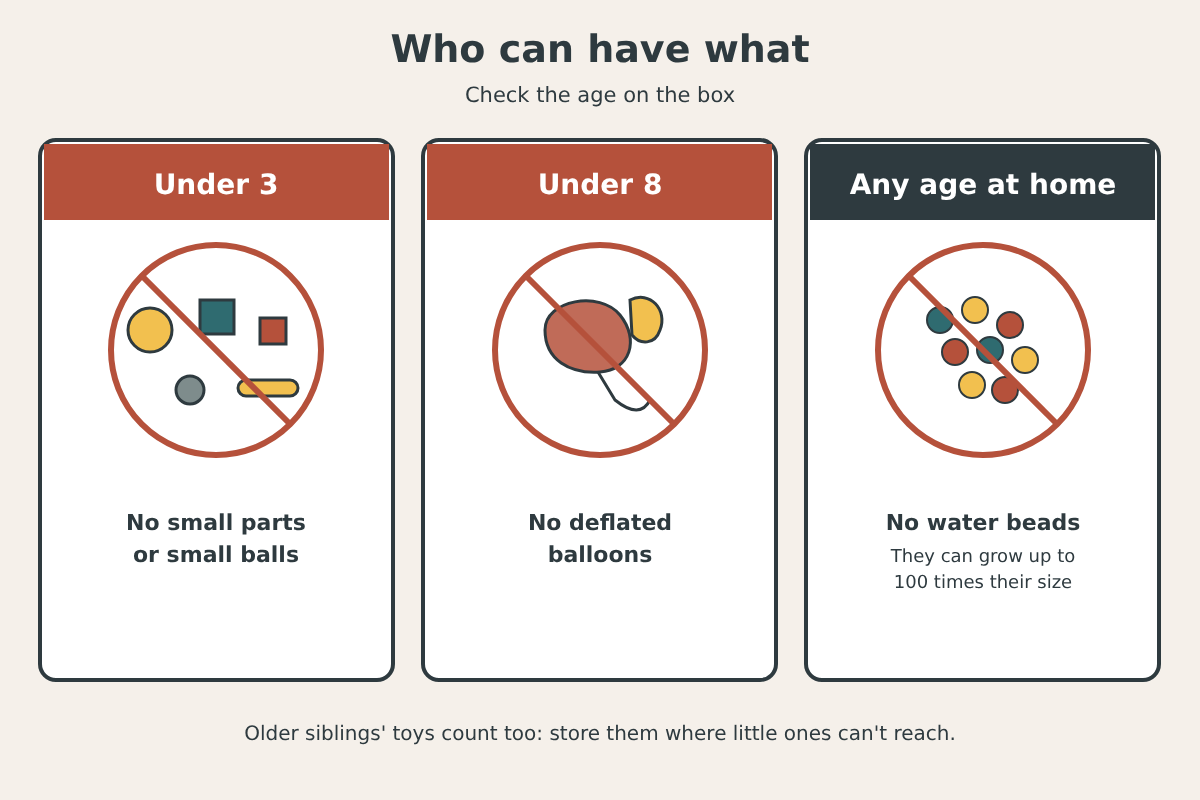
- Keep small parts and small balls from children under 3. That includes toys meant for older siblings.
- Keep deflated balloons from children under 8. Store uninflated balloons where younger children can't reach them.
- Look for the choking-hazard warning when you shop online. It should be on the product page, not just the box.
- Buy from stores and sites you know. Be wary of deals that look too good to be true.
- Check secondhand toys against recalls. Search CPSC.gov/recalls before you buy.
- Leave water beads off the list. CPSC says not to let children play with them.
- Buy the helmet with the scooter. And make it part of riding every time.
- Clear the wrapping as soon as gifts are open. Plastic film, ties and small packing pieces go straight in the trash.
- Save the Poison Help number. 1-800-222-1222, open 24 hours a day.
Why each one matters
The age grade is a safety rating, not a guess about what a child will enjoy. CPSC's first tip is to follow the age guidance and other safety information on the packaging and to choose toys that match each child's interests and abilities.
Small parts are the main choking risk. CPSC says to keep balls and toys with small parts away from children younger than 3, and choking on small balls or crayons is among the leading causes of toy-related deaths in its latest report. In a house with children of different ages, the risk comes from the older child's gift, so plan where those toys will be played with and stored.
Balloons get their own, older cut-off. CPSC says to keep deflated balloons away from children younger than 8.
Online listings need a closer look. When you buy toys online with small parts, balls, marbles or balloons, CPSC says to look for a choking-hazard warning on the seller's product page, since you can't read the box until it arrives.
Where you buy matters. CPSC advises buying toys from stores and online retailers you know and trust, and being wary of online deals that sound too good to be true, as these toys may be hazardous or counterfeit. In fiscal year 2024, CPSC and US Customs and Border Protection seized nearly 1.6 million dangerous or illegal toys, nearly 101,900 of them over lead content.
Secondhand toys can be good value, but a recalled toy doesn't announce itself. CPSC says to verify recalls at CPSC.gov/recalls before buying secondhand products online. Search by the toy's name and maker.
Water beads are the item to skip entirely. They are small, often colourful balls of super-absorbent polymer that can grow up to 100 times their size in water, and swallowed beads can keep growing inside a child and block the intestines. CPSC counts nearly 7,000 water-bead ingestion injuries treated in US emergency departments from 2018 through 2022, and the death of a 10-month-old girl in 2023. A federal standard now covers water bead toys made after March 12, 2026, but CPSC notes that some water bead products aren't sold as toys and fall outside it. Its advice is not to let children play with water beads, and to throw away any toy, such as a bead-filled ball, if the beads start to come out. If you think a child has swallowed one or put one in an ear or nose, get medical care right away.
Scooters are the biggest single source of toy injuries. In CPSC's 2023 figures, non-motorized scooters accounted for 53,000 injuries across all ages, and for more than one in five toy-related injuries among children under 15. CPSC says to give safety gear, including a helmet, with scooters and other riding toys, and to make sure children wear it every time.
Wrapping is a hazard after the fun. CPSC says to throw away plastic wrapping and other packaging immediately after the gifts are opened.
The Poison Help line (1-800-222-1222) is the number CPSC gives for an emergency such as a swallowed water bead, and it is answered around the clock. Save it in your phone before the holidays. You can report a dangerous toy or an injury at SaferProducts.gov.
If you're travelling with little ones, the checklist for flying with a baby or toddler covers the trip. For the tree the gifts sit under, see what to check before putting up a Christmas tree.
Mistakes people make
- Buying the toy a child wants without reading the age grade.
- Forgetting that an older child's building set will end up on the floor near a toddler.
- Trusting a bargain listing from a seller you've never heard of.
- Buying a secondhand toy without checking it for a recall.
- Giving a scooter without a helmet.
- Leaving plastic film and ties on the floor while everyone opens the next gift.
Ready check
- Does every toy match the age on its box and the child it's for? If not, see items 1 to 3.
- Did you buy from sellers you trust, and check secondhand toys for recalls? If not, see items 5 and 6.
- Are water beads off your list, and does every scooter come with a helmet? If not, see items 7 and 8.
- Is the Poison Help number saved in your phone? If not, see item 10.
