Before you use a space heater this winter: 10 things to check
Before winter's first cold snap: pick a heater with tip-over shut-off, plug it straight into the wall, keep 3 feet clear and switch it off at bedtime.
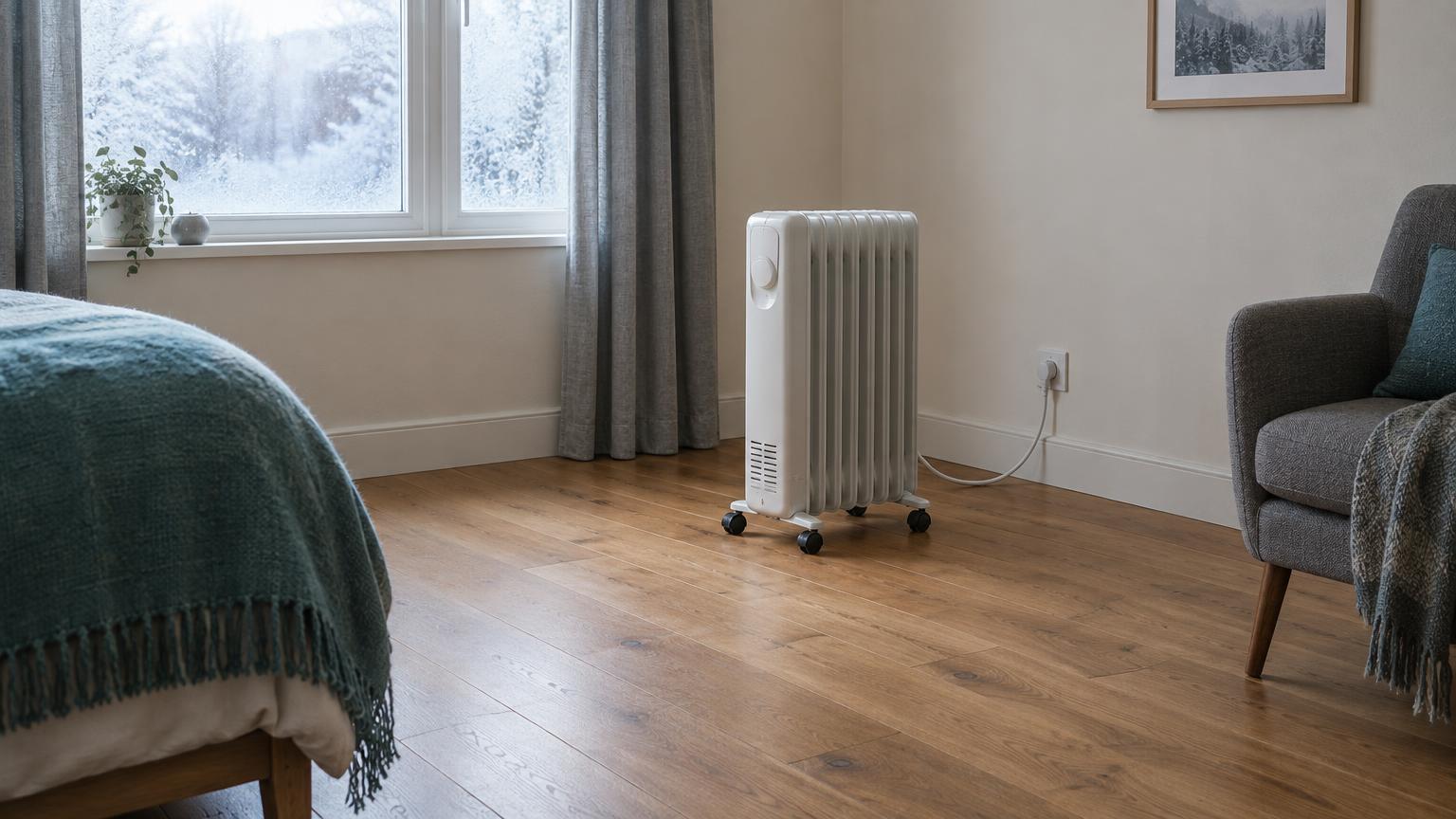
Ready when: your heater carries a testing-lab label, has tip-over and overheat shut-off, plugs straight into a wall outlet, and has 3 feet of clear space on every side.
Winter starts on Monday, December 21, 2026, and the first hard cold snap is when space heaters come out of closets. They earn a careful setup. NFPA, the US fire-safety association, counts space heaters and heating stoves as behind 30% of home heating fires in 2020 to 2024, but 73% of the deaths from those fires. Nearly half of home heating fires (46%) happen from December through February. This list follows NFPA's space heater tip sheet, the US Fire Administration (USFA) and the US Consumer Product Safety Commission (CPSC), checked in November 2026. It is written for portable electric heaters; if your heater burns fuel, follow its manual and local codes, and see the carbon monoxide steps below.
The Before List
- Buy a heater with a testing-lab seal. Look for the mark of a qualified testing laboratory on the heater or box.
- Choose one with a thermostat and overheat protection. It should switch itself off before it gets dangerously hot.
- Check for tip-over shut-off. The heater should turn off if it falls over.
- Plug it straight into a wall outlet. No extension cord.
- Give it 3 feet of clear space. That includes bedding, curtains, furniture and people.
- Set it on a solid, flat floor out of the walkway. Never in front of an exit.
- Keep children and pets away from it. Make the 3-foot zone a no-play zone.
- Turn it off and unplug it when you leave the room or go to bed. A heater runs only while someone is awake in the room.
- Never heat your home with the oven. Use equipment made for heating.
- Fit carbon monoxide alarms if anything in your home burns fuel. One on every level and outside sleeping areas.
Why each one matters
The testing-lab seal is your evidence that the heater's design has been checked against a safety standard. NFPA's first tip is to buy a heater carrying one.
Thermostat and overheat protection keep a heater from running flat out until something fails. NFPA recommends both.
Tip-over shut-off matters because heaters get knocked. A dog, a child or a trailing blanket can push one onto its face, and NFPA says your heater should have an automatic shut-off that turns it off if it tips over.
The wall outlet rule surprises people, but heaters draw far more power than lamps or phone chargers. NFPA says to plug the heater directly into the wall outlet and never use an extension cord.
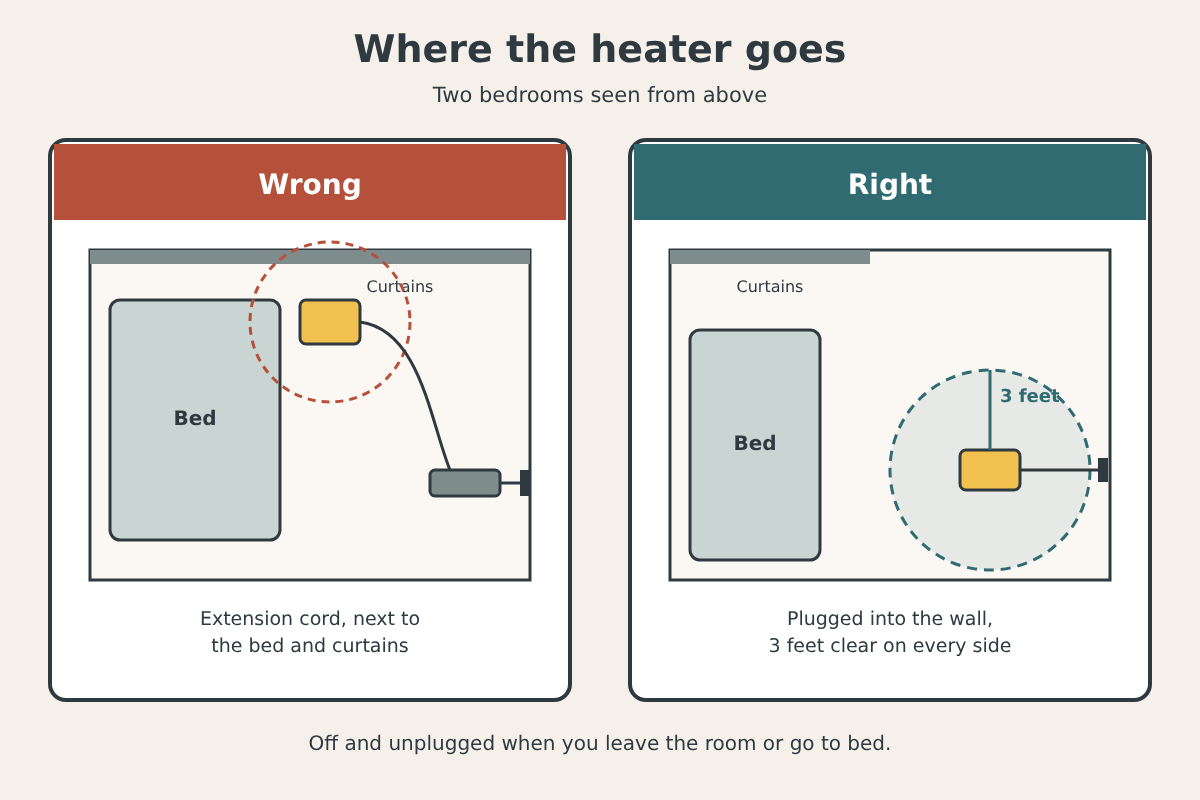
Three feet is the distance both NFPA and USFA use. NFPA says to keep the heater at least 3 feet from anything that can burn, including people, and USFA gives the same distance for all heat sources: fireplaces, wood stoves, radiators, space heaters and candles. Measure it once in each room you'll use the heater in. A bed, a sofa and floor-length curtains are the usual culprits.
A solid floor and a clear path stop the heater being kicked, tipped or blocking your way out. NFPA advises a solid, flat surface, keeping heaters out of foot traffic and never blocking an exit. Rugs that bunch up and soft furniture are not solid surfaces.
Children get close to warm things. NFPA's tip sheet says to keep children away from space heaters, so put the heater where they can't reach it rather than relying on reminders.
Turning off is the step people skip. NFPA and USFA both say to turn space heaters off when you leave the room or go to bed, and NFPA adds unplugging them. USFA's figures show why: portable heater fires were only 3% of home heating fires in 2017 to 2019, but 41% of the fatal ones. A sleeping person can't react to a fire that starts beside the bed. Warm the bedroom before you get in, then switch off and use extra blankets.
The oven is not a heater. USFA's message is simple: never use an oven to heat your home.
Carbon monoxide (CO) has no colour or smell, and CPSC says more than 200 people in the US die each year from accidental CO poisoning linked to consumer products that is not caused by a fire. If you have a gas furnace, water heater, fireplace, stove or any fuel-burning heater, CPSC recommends battery-powered CO alarms, or alarms with battery backup, on every level of the home and outside sleeping areas. Learn the symptoms: headache, dizziness, weakness, nausea, vomiting, sleepiness and confusion. If you suspect CO poisoning, get outside to fresh air and call 911. If the power goes out, never run a portable generator indoors or in a garage; CPSC says to keep it outside, at least 20 feet from the house, with the exhaust pointed away.
Last, the rest of the heating system. USFA advises having heating equipment and chimneys cleaned and inspected by a professional every year, which is worth booking before the cold arrives. If you'll be away over the holidays, the checklist for leaving your house empty covers what to leave on, and a heater isn't on that list. Putting up a tree as well? Keep it 3 feet from heat sources, as the tree checklist explains. For the drive to see family, the winter car checklist has the road side covered.
Mistakes people make
- Running a heater from a power strip or extension cord because the wall outlet is behind the bed.
- Parking the heater beside the bed, the sofa or floor-length curtains.
- Leaving it on all night to keep a bedroom warm.
- Drying clothes or towels over or beside the heater.
- Using the oven to take the chill off a cold kitchen.
- Having fuel-burning appliances in the house and no CO alarm.
Ready check
- Does your heater have a testing-lab seal, overheat protection and tip-over shut-off? If not, see items 1 to 3.
- Is it plugged straight into the wall, with 3 feet of clear space around it? If not, see items 4 and 5.
- Will it be off and unplugged whenever the room is empty or everyone is asleep? If not, see item 8.
- If anything in your home burns fuel, do you have a working CO alarm on every level? If not, see item 10.
